
Your Energy Bill & Rates Explained
Blog updated May 2026
Energy bills can be confusing to read, so let’s break down the charges that make up your bill, how those rates are set, and what steps you can take to reduce your energy costs.
Your energy bill is calculated by your energy rate times your monthly energy usage, and is made up of four types of charges:
- Electric generation charge – the actual power you use.
- Electric delivery charges – also known as transmission and distribution, this pays for the infrastructure used to get energy to your home or business, such as power lines. As of March 2026, this includes a ‘Base Service Charge’, a flat monthly fee paid to PG&E for your connection to the grid.
- Power Charge Indifference Adjustment (PCIA) – this charge represents the costs PG&E incurred as a result of historically buying energy to serve you. All SVCE and PG&E customers pay this fee.
- Gas charges – we won’t get into these in this article, but PG&E manages all gas services for SVCE customers.
A portion of what you pay in 1-4 above goes to fund statewide programs paid by all customers.
- Public Purpose Programs – this includes statewide costs to fund energy efficiency and payment assistance programs.
- Other Non-Bypassable Charges – including funding for wildfire mitigation and other funds.
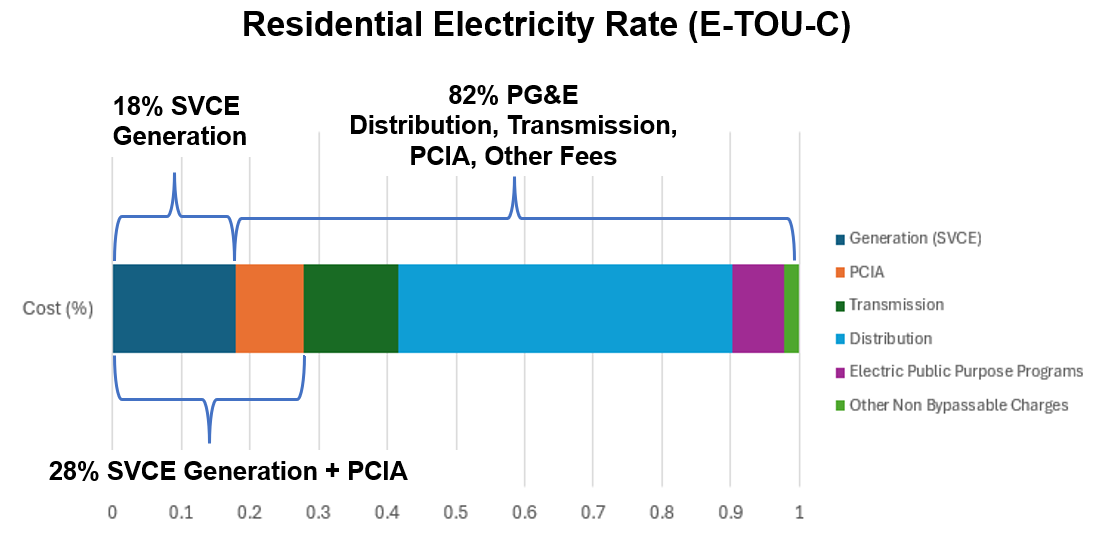
Silicon Valley Clean Energy (SVCE) customers buy their electricity from SVCE via their PG&E bill. Everything else (gas, electric delivery, and additional charges) are managed by PG&E.
Electric Generation Charges – paid to SVCE
SVCE provides customers with clean electricity that shows up on their PG&E bill as “Electric Generation Charges.” SVCE’s power comes from solar, wind, hydro, geothermal and other sources, in addition to batteries, which increase grid resilience and allows clean energy to be used even when the sun is not shining.
Transmission, Distribution, and Additional Charges – paid to PG&E
About 80% of the average residential electricity bill is comprised of transmission, distribution and other charges.
Customers pay PG&E to get electricity to their home – this service is most commonly referred to as transmission and distribution.
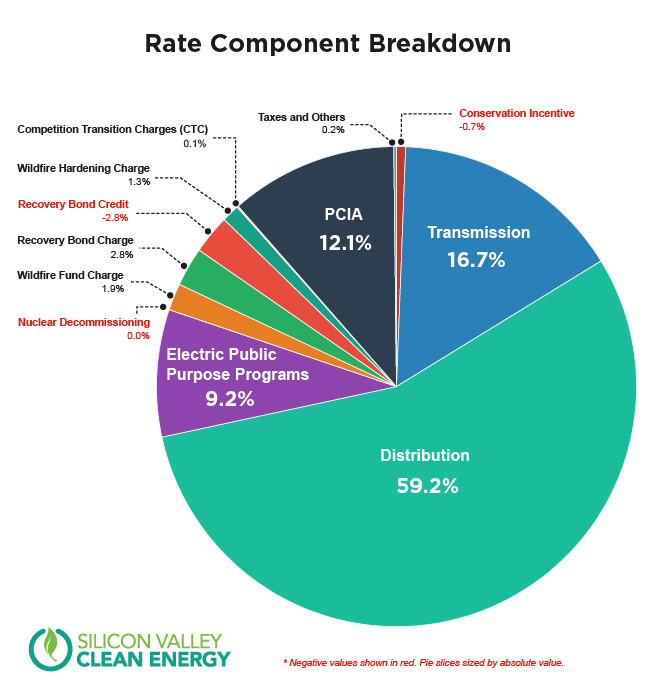
Transmission charges pay for the infrastructure necessary to move electricity from generation sources around California and the West to the local distribution network. The distribution charges pay for the local network of poles and wires that carry electricity from the transmission system to homes and businesses.
Additional fees and charges are also embedded in these rates and collected by PG&E. These include Public Purpose Programs that fund regional or statewide programs such as income-qualified bill assistance and energy efficiency, and non-bypassable charges that fund various efforts, such as wildfire prevention.
Transmission, distribution, and the additional charges paid to PG&E constitute a majority of the average customer bill. Over the last five years, these charges have increased by nearly 85%, impacting all customers in the PG&E territory (including SVCE customers).
How Rates Are Set
How SVCE generation rates are set.
SVCE is a not-for-profit public agency and revenues in excess of operating costs are returned to the community through customer programs and services and competitive rates. For the average household in Silicon Valley, electricity generation makes up nearly 20% of the overall electricity bill.
What determines that rate? The SVCE Board of Directors, elected officials representing each of the 13 SVCE member communities, votes on how the agency sets its generation rates.
SVCE first considers the forecasted costs to provide its service, including cost uncertainty under various scenarios, and then forecasts revenue to recover those costs. Rates are determined based on the forecasted revenue requirement and overall projected load for all SVCE customers. The SVCE generation rate also includes the cost of the Power Charge Indifference Adjustment (PCIA).
This approach provides SVCE customers with clean electricity at a competitive rate across all rate plans and ensures that SVCE is financially secure. This allows SVCE to maintain stable rates for customers and execute long-term contracts for renewable energy.
SVCE customers are saving money on electricity generation costs compared to PG&E customers, but generation prices have recently increased. This is due to higher costs for key compliance products SVCE must purchase, including renewable and carbon-free resources and capacity used to ensure system reliability. While load-serving entities such as SVCE are working to add more capacity to bring down prices, backlogs from the COVID-19 pandemic and increasing demand mean it will likely take some years for the industry to catch up.
SVCE works to balance our clean power portfolio with affordability and reliability in mind. Nearly 90 cents of every dollar is spent on power supply costs; in total SVCE has contracted for more than 1000 megawatts of clean electricity generation and 2000 megawatts of battery capacity. Many of these contracts are for brand-new clean resources, helping to increase state-wide supply.
How PG&E transmission and distribution rates are set, and why other additional charges are increasing.
As mentioned above, the rest of your bill is made up of services managed by PG&E. So, how are those charges determined? PG&E submits its rate details to the California Public Utilities Commission (CPUC) for review. In this review, the CPUC determines if the rates are fair based on the projections provided and the utility’s associated costs.
As customers have noticed, these rates have increased drastically in recent years. In 2024, the CPUC Public Advocates Office reported that PG&E rates have risen 127% since 2014, with nearly half of the increase happening between 2022 – 2024. PG&E stated that these transmission and delivery rate hikes are due to costs incurred to ensure the safety and reliability of its energy services including efforts to mitigate wildfire risks.
The chart below shows how wildfire mitigation is built into PG&E’s transmission and distribution costs and how it also appears as separate additional charges. The chart includes all of the “other charges” that appears on bills.
How SVCE Supports Customers
Since 2017, SVCE customers saved more than $203 million on electricity bills. And since 2020, SVCE has provided an additional $15 million in bill savings to customers enrolled in the income-qualified CARE/FERA program.
Many resources are available for customers who need additional support paying their energy bill. These are funded through the state’s Public Purpose Programs.
Get bill assistance – SVCE customers can participate in financial assistance programs like Medical Baseline, California Alternate Rates for Energy (CARE), Family Electric Rate Assistance (FERA) and more. Learn more about payment assistance >>
Know your rate – use the PG&E Compare My Rate tool to see which energy rate is best for you. If you are on a time-of-use rate, be sure to prioritize energy use during off-peak hours (avoid high use from 4 – 9 p.m.) so that the energy you are using is cheaper. Compare rate options >>
Use energy efficiently by ensuring you are doing all you can to lower your energy usage. This includes investing in high-efficiency lighting and appliances and proper weatherization of your home. Use the SVCE Do-It-Yourself Energy Savings Toolkit or go through a free home energy audit. Explore energy efficiency programs through PG&E or BayREN.
Have solar? Consider adding a battery – Add batteries to your existing solar system to store your clean energy for use in the evening hours when grid electricity is more expensive. See battery options >>
Additional Energy Bill and Rates FAQs
Need help understanding your energy bill?
Visit svcleanenergy.org/your-bill for a step-by-step guide on how to read your PG&E bill.
What is SVCE doing about energy affordability?
SVCE has maintained competitive rates since its service started in 2017. SVCE rates in 2026 are one percent lower than PG&E’s. SVCE advocates at both the state legislature and regulatory bodies for policies that balance affordability with a clean, reliable and safe grid and aims to connect customers most impacted by price increases to available payment assistance programs.
Will upgrading to all-electric equipment in my home mean that I will be paying more for energy?
Even with increasing electricity prices, switching to efficient, electric appliances paired with a time-of-use energy rate can result in bill savings, a recent study showed. However, savings can greatly vary based on home type, appliance efficiency, and time of energy use. Customers interested in benefiting from clean, electric appliances can use the Go Electric Advisor to evaluate plans that best fit their needs.
What is the Base Services Charge and how will that impact my bill?
PG&E, along with all other investor-owned utilities in the state, is restructuring a portion of the transmission and distribution fees on residential customer bills. The Base Service Charge recategorizes some costs associated with infrastructure, maintenance, energy programs, PG&E call center services and billing into a flat fee instead of a volumetric fee as it was previously charged.
The fixed charge only applies to the PG&E portion of customer bills (transmission and delivery costs). There will not be a fixed charge for the SVCE portion of bills (generation).
All residential customers in PG&E’s service territory, including rooftop solar customers, will pay the Base Service Charge, which was implemented in March 2026. The monthly Base Service Charge is $6 for customers enrolled in CARE, and $12 for customers enrolled in FERA, and $24 for all other customers, with slight variances month-to-month based on total days per billing period. The Base Service Charge is not a new, additional fee and is intended to be offset by a decrease in volumetric payments.
See more FAQs about bills at svcleanenergy.org/rates-and-billing.